
If you have spent any time outdoors during extreme winter weather – maybe like Denmark’s recent weeks of freezing temperatures and ice – you know how quickly even short walks can turn into a slippery challenge. It is in seasons like these that safety moves from a checkbox item to something we all think about: safe walkways, reliable stairways and secure access points, no matter the conditions. Making sure our infrastructure is ready for whatever climate change is throwing at us.
I don’t know if you ever looked down at the different appliances you walk on – winter or summer? I sure did not think about it until I started working at a steel grating company. And then the job colours your lenses, and I suddenly notice how many places insist on outdoor steel-grated staircases, entrances or walkways, and I thought: brilliant! Here, the snow can build up between the meshes, keeping the grating slip-resistant, or the perforated holes in the grating make sure that even ice will not make you slip.
At PcP, we think about these challenges every day. As engineers, project managers etc., evaluate anti-slip stair safety products for new and existing infrastructure, one solution stands out: steel grating. It is robust. It is low maintenance. And it is one of the most effective ways to ensure safe, anti-slip walkways, doorsteps and staircases all year round.
Let us explore why steel grating belongs at the top of your specifications list, especially when anti-slip stair treads and other surface safety concerns are on the table.
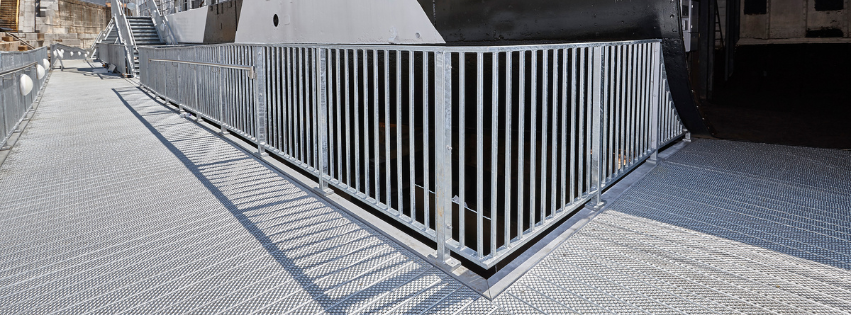
Any engineer or project manager knows that skip-and-fall accidents on stairs and walkways are more than inconvenient: They are a serious safety risk. Did you know that in Denmark, every fifth workplace accident is caused by falls, slips, or stumbles? Even gentle slopes can become treacherous when wet, icy, or muddy.
In high-traffic industrial, commercial and public applications, the solution is not just better footwear – it is better surface design.
This is where anti-slip stair safety products come in:
And among these, steel gratings often deliver the best combination of performance, durability and versatility.
You rarely think about the surface beneath your feet, until it matters But then once you do, choices matter. Steel gratings offer inherent anti-slip benefits because of their design. Take our famous mesh gratings, like our Elefant® brand, for example:
The advantages make steel grating a smart choice for stair treads, walkways, platforms and mezzanine surfaces. That is why so many engineers specify it for both safety and longevity.
Auckland Castle needed new access walkways, stairs, and landings for visitors to use on their way to the top for a breathtaking view. They were looking for a solution that provided a robust, visually subtle and slip-resistant access system that complies with strict British safety standards and the architectural vision. In a close partnership with PcP delivered a tailored solution that met every requirement. The solution used:
The stair treads were enhanced with a bespoke nosing solution, allowing aftermarket nosing to be installed post-installation while maintaining integrity and safety without sacrificing appearance. This also reduced slip-and-fall risk across all access areas.
This collaboration is one of many that demonstrate how versatile grating solutions can address not just structural issues but also operational and ergonomic challenges.
Our vision is to be recognised not just as a supplier, but as a trusted advisor and total solution partner for anti-slip stair safety products and steel grating solutions.
When it comes to anti-slip stair safety, the right surface can make all the difference. Steel grating offers durable, high-performance traction that keeps people safe in all conditions - from icy winter mornings to rainy afternoons and everything in between.
If you’re specifying stair treads, walkways, ramps, or platform surfaces, consider how engineered steel grating can reduce risk, improve durability, and deliver real value over time.
Because safety is not an accessory - it’s engineered.
Sources:
