It’s typically chosen for walkways and platforms because it’s strong, long-lasting, and requires little maintenance. Bring it into furniture, and those same qualities translate neatly: a bench that won’t sag, shelving that doesn’t mind damp boots, a table surface that shrugs off scratches and looks better for a few knocks. In steel or aluminium, it can last for decades with minimal maintenance.
But the real appeal is flexibility. Grating isn’t ‘one look’. Change the mesh, bar thickness, edge finishing, or surface treatment, and it goes from raw and rugged to surprisingly refined. That variety is exactly why architects and makers are increasingly using steel gratings in ways most people don't expect.
And that’s where this post goes next: practical, slightly unconventional furniture ideas that use steel grating as more than just an industrial detail. If you already specify it for safety and drainage, the interesting bit is what happens when you start specifying it for furniture too.
In typical architecture, when you use steel gratings, you would typically need specifications for drainage, slip resistance, load, airflow or light. Maybe you are thinking these specifications are only relevant to footpaths, ventilation systems or facades. But you can apply the same properties to furniture as you do to design features. Here is how:
A bench or an outdoor table with drainage, for example, provides outdoor furniture that doesn’t get too wet and drains quickly. Perfect for Nordic climates where ‘dry outdoor furniture’ is a rare luxury. This also means that other fluids or dirt cannot build up on the surface. A reliable airflow reduces condensation and mould build-up in wet zones. Furniture with open areas, like holes between pieces, gives the space a visual lightness. And the stiffness you rely on for loads and bearings gives slimmer frames and longer lifespans
Steel grating furniture can have many different applications, and steel is a real working material with structural, hard-wearing, and visually open qualities, making it ideal for an industrial style that feels honest and not staged. Here are some ideas where they can be used:
Use a steel grating as a ‘working surface’. Think terraces, gardens, balconies, entrance zones, etc. If you take a mesh grating, for example, you have an object that allows water and dirt to pass through rather than sit on the surface. A great choice for something by the front door, where everything is wet for half the year. Additionally, an outdoor side table won't blister, swell, or fade like timber can.
Make wall-mounted shelves or pegboard alternatives. In an open-plan office, a studio or utility space with a steel grating can give an industrial feel without visually blocking the room. They are also forgiving in humid areas, such as laundry rooms or bathrooms with poor extraction. And a grating panel on the wall works as a grid for hooks, hanging rails, plants, and even small lamps.
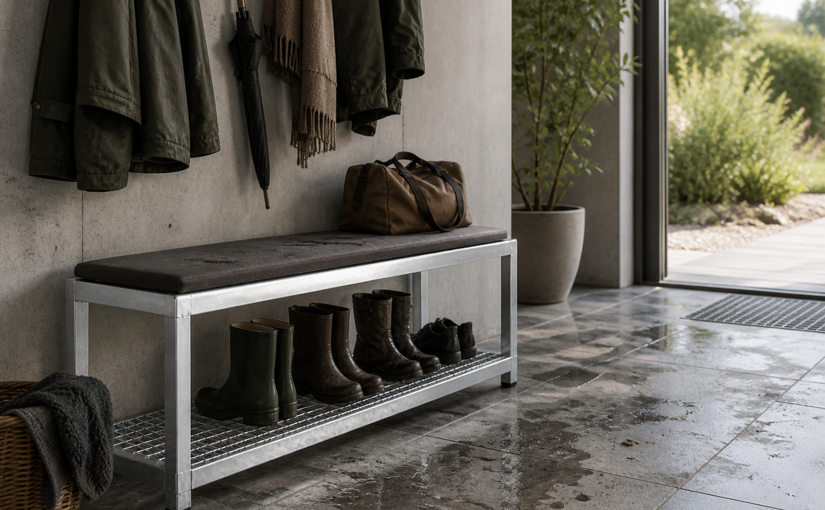
In wet, high-wear zones like pools, outdoor showers, garden rooms and rooftop terraces, steel grating is a sensible alternative when timber starts to struggle. It’s built to live with water, so in a domestic setting, you get fewer surfaces that need babying. A simple threshold bench outside a garden room, for example, becomes a place to drop muddy boots, wet towels or sandy feet without worrying about staining, swelling, or constant upkeep.
And if the furniture needs to move with the season, aluminium grating makes that even easier. It’s noticeably lighter to handle, but still stable enough to sit on, lean against, or use as a working surface, so “practical” doesn’t mean flimsy.