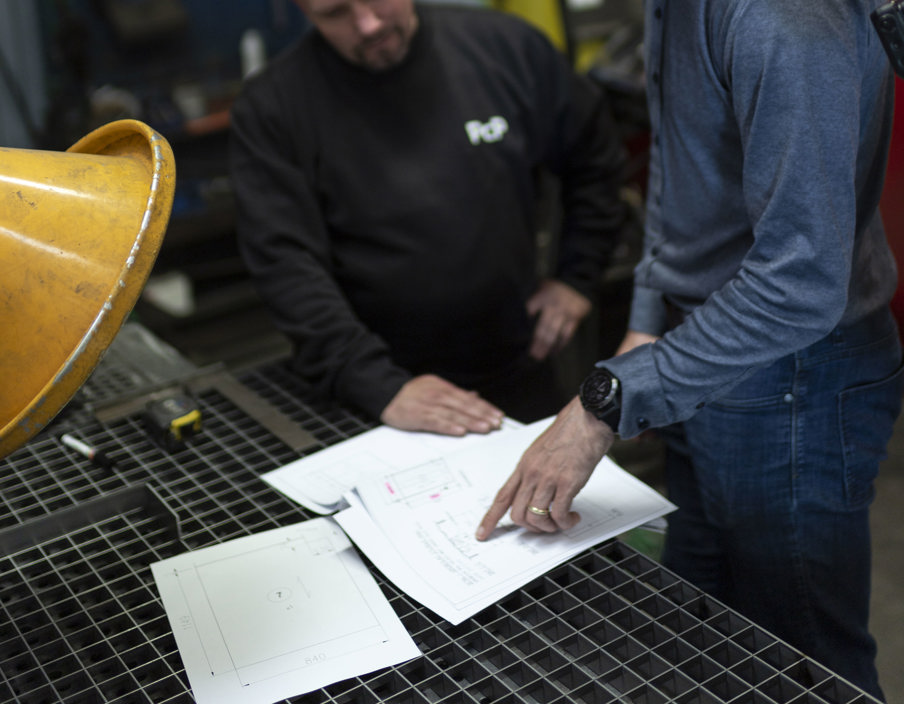
Simply put, press-welded gratings are your trusted friend for heavy days.
Our press-welded gratings, originally known as Elefant® gratings, are manufactured by resistance welding each bearing bar and crossbar at every intersection. Pressure is applied while an electrical current generates temperatures of approximately 1,500°C at the point of contact, forming a permanent bond between the bars. This process produces a rigid, durable grating with exceptional structural integrity and high load-bearing capacity. Panels can be rolled to a radius or fabricated with ease, without compromising strength.
Each panel is programmed to achieve precise bar centres, ensuring an equal number of apertures across the width. This results in a consistent mesh pattern and a uniform, high-quality appearance, one of the key advantages of press-welded gratings
Our PressLock gratings are the better-looking brother of mesh gratings, combining structural performance with architectural appeal.
Instead of welding, the bearing bars and crossbars are mechanically interlocked under high pressure. The bars, usually made of cold-rolled flat steel, are precision-punched and pressed together, then secured with a welded flat-edge bar to form a stable panel. The result is a lightweight grating with reliable load performance, suitable for walkways, platforms and cladding. In many European countries today, the press-locked grating is the star of mesh gratings, as its production enables a wide variety of products, and at PcP, we have limitless possibilities of customisable solutions. The application possibilities are almost endless; only your imagination sets the limit on what is possible with a press-locked grating.
In summary, although mesh gratings might seem similar at a distance, up close they have distinct features. Whether you need solutions for walkways, stairs, platforms, façades, ceilings, or other purposes, mesh gratings can create safe and efficient designs. Structurally, they serve different purposes:
Both types are framed with another flat bar around the edges on all four sides. Where the edging bars meet at the corners, they are welded to further enhance the grating’s stability. Additionally, an appropriate number of bars are welded to the edging bars for extra reinforcement.
With decades of experience in steel grating and safety solutions, we're ready to support your project from first idea to final delivery.
Let us help you with your next project.